Saturday, March 5, 2011

Party Wall between No.2 and No.4

We saw signs of problems on the chimney in the party wall, and so asked Costa to get some pictures of the party wall.

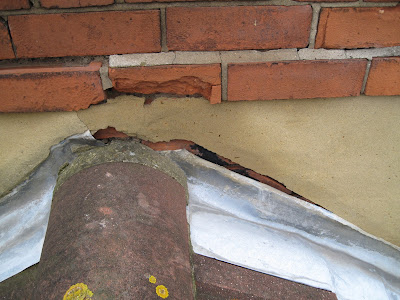
The pointing binding the flash into the wall is not exactly an expert job. The top of the mortar bead should not  protrude or be flush with the brick, it should create a small overhang to encourage water to fly off the edge of the brick.

There are some small cracks that can probably be saved. 

Otherwise, the flashing on the south side (roof of No.4) seems to be in good order.

The flashing on the north side is bound in by a layer of rendering. The previous owners (Lakefield Estates) couldn't be bothered to do a quality job, but it is still effective.

On the other hand, the caps have not been laid properly. They are probably letting water down onto the wall below and causing damp in the brickwork. We have to fix this.

Interestingly, you can see how the water spills off the pointed corner of the capstone and where it hits the lead below.

Look at the aerial cables.

The chimney has a few spoiled bricks and some lost pointing. That needs fixing too.

I'm really surprised at the way the aerial cables are just thrown over the roof. 

View down the chimney.  If the chimney won't be used, then it ought to be capped with a rain cover, just a piece of pottery or plastic dropped into the pot.


The concrete cap needs to be renovated. Water flowing off the cap will pool on the flat surface and soak into the mortar. It will then channel down to the lower part of the chimney. In cold weather the wet mortar and bricks will suffer frost damage. 


The chimney is showing signs of failed pointing and damaged bricks. Some of these bricks need to be replaced.


Failed pointing makes problems spread like a virus...  The damp has probably gone down behind the concrete render.


 No lichen on the south side...?  Odd.


Andrew from No.4A came to talk about the damp and the aerials... He's taller than me and has two viable legs, so he managed to reach through the window and snap a few shots of the damp corner.


Moss... Not a good sign.

Grass in the gutter!  That's good and bad. We can easily remove the grass, but the root cause must be the slope of the gutter. That will need adjusting.


There is damp above the little garden. So there's something wrong above it. 
From this picture is looks like the flashing on No.4A is possibly guiding water onto the brickwork instead on into the gutter.


Click me to go to Part Deux


Friday, March 4, 2011

Brick Repairs

There were a large number of bricks that have been damaged by frost. These must be replaced to prevent the problem spreading. 

Lost mortar allows water to soak into the brickwork. Frost freezes the water which expands as it turns to ice, and so breaks the brick material. Once the surface becomes loose, the porous interior soaks up water even faster, more water can accumulate and the process accelerates. The brick face eventually falls off, and the problem spreads to the neighbouring bricks.

The problem seen above either started in the two vertical mortar channels above the damaged brick, or in the small porous yellow brick between the two.

The damaged surface is broken away easily. Then the brick it broken up using a chisel.


Once the brick is removed, the mortar is also cleaned out.


New bricks will be inserted and mortared into place. It is important that the new mortar has the same characteristics as the surrounding mortar, otherwise it will expand and contract differently, and break the weakest area around it.


Damaged bricks above the sill and window below allow water to enter and channel towards the wooden lintel. The lintel can then rot and cause the wall to sag.


Once the water gets in, it channels down around the bricks. The frost strikes, and mortar fails. Imagine how many bricks would need to be replaced once the frost got into these.

In this case, the weakening mortar has caused the pillar to sink, and now the right hand window and frame is distorted. We'll probably have to extract and replace the window. 


A pair of bricks has failed on a chimney stack.  The change in angle of the surfaces probably created an entry point for water to soak into the mortar and then into the bricks above and below. 

The sloping surface has channelled water along the chimney stack. 

Look closer, and we find that the softer mortar is loose or missing.

Once the surface layer loses its support, or if the material is of different strength, cracks will appear and create new entry points.
Once we start poking around, we find that the bricks have failed and must be replaced.


If we had caught these problems a few years ago, the cost would be so much less today!  Replacing one brick is so much easier.

Thursday, March 3, 2011

Steels and Chimneys

Steel Beams


We've hit a slight delay. The steel beams were delivered, but turned out to be so heavy the team could not lift them. I have to admit that I thought this sort of thing was done with cranes. These things weigh 56kg per metre, and I reckon we're talking nearly 8 metres each.


They've taken the steels away and are going to cut them in half. They will supply a splicing kit to tie them together.


In the meantime work will switch to doing exterior repairs.


Chimneys


The planning permission permits the removal of the two rear chimneys. Both chimney stacks are in very poor condition. One has been capped, the flue is broken, and it's completely unusable.


The repair cost is £400 per chimney. The cost of removal is £310 for the pair. Caroline (flat owner downstairs) is jointly responsible for repairs and naturally wants to keep costs to a minimum. So it's a bit odd that she now wants to keep the chimneys. She says that at a minimum we should keep the stack above the dining rooms.


Well, OK. I've told the contractor that we will keep that chimney and that the other one will be removed.


Tuesday, March 1, 2011

Dishes and Yagi Corner Reflectors

We need to move the existing Sky dish.  It belongs to Caroline in flat 2.


The dish shown by the red arrow is to be moved. It could go to the chimney shown by the blue arrow.  But the dormers may block the line of sight to the satellite.


There is another suitable chimney stack on the other side of the house, there are 4 shared owners of that stack!  There is also a brick party wall which projects about 50cm above the roof tiles.


The existing dish has 4 cables, 1 going over the roof to the front of the house, and 3 dropping down to the rear of the ground floor flat.


(The black cable which runs horizontally is the phone line for the 1st floor flat.)


The grey dish on the right hand chimney is old and will be removed.

Note that there is now scaffold across the whole of this wall, and the right hand side, and access is very easy.

The nearer of the two chimneys shown below will be removed.


There is an existing UHF yagi antenna in the loft. This is in the way of builders installing steel beams and joists and needs to be moved outside. It will probably go on the same site as the dish.


I also want a new FreeSat or Sky dish for use by two independent users once the loft is habitable (i.e. two different receivers supplying two TVs). 


The loft conversion will have two dormer windows projecting from the rear roof. Their forward edge will be ahead of the chimney. This could present problems with getting a line of sight to the satellite.


Is there enough space to mount 2 dishes and a UHF aerial on the same chimney?
If we mount the dishes on the suggested chimney, will they be blocked by the dormer windows that will extend out from the roof?  


If so, then maybe we can mount them on the party wall to the left of the dormer windows. (UHF aerial ahead of dishes, for best reception). This would be very inconspicuous. 


Friday, February 25, 2011

Let's Get Started


So here we go. The scaffolding goes up on 21 February.

The aim is;
  1. Repair the outside of the building and 
  2. Convert the loft to living space. 
We should save on costs by combining the two pieces of work.


Pieces of moulding have been falling off for a while. The dark patch between the windows  indicates some serious weathering. This work has been postponed too long.


The rear addition is a little better, but a closer look will reveal some developing problems.  And what's that loose cable on the roof?


I predict a few discussions about painting... 


The vertical surfaces of the windows have been painted a few years ago, but quite clearly the sills have not been painted for a long time. They are in a bad state.


We also need to get rid of graffiti that Harry painted a few years ago.


There are quite a few bricks that have lost their surface and allowing weather to penetrate. That will reduce the wall's strength and will show up as a patch of damp on the interior wall surface. 


Here's an example on the chimney.  These bricks may need to be replaced. 


The Sky dish is redundant. Why wasn't it taken down?  We'll probably get charged for removing it.


The rear addition chimneys are worse. 


Unfortunately, old foam footballs and discarded Sky dish attachments tend to block troughs which then clog up with debris, and water soaks into the brickwork.


The best solution for this sort of things is probably to remove the stack. The pointing is deeply shot, and the lower bricks have lost their surface. The concrete cap is probably channelling rain onto the flat brick surface where it will soak into the mortar.


The party wall contains a central chimney which is also showing serious signs of failure.


The flat surface will collect water which then soaks into the brickwork causing the mortar to disintegrate.  The dark colouration is caused by water flow and pooling water.


Here is the cause of the damp in 2A and 4A. These capping stones should be cemented to prevent water going between the ends. 


The end cap is stopping water from flying off the end and directing it into the brickwork.  

This chimney is in better state, and the cap is complete.  


But obviously there's a tile problem.  That looks very recent. Do we have heavy crows around here?